The plan usually starts on the way home. You are stuck in Accra traffic, or squeezed into a trotro, working out with some precision exactly when you will begin learning to code. Not tonight, because tonight you are tired. Maybe the weekend, once the errands are done. Maybe January, when work calms down. By the time you get in and take your shoes off, the start date has already moved back a month.
Almost everyone who learns to code alongside a job goes through some version of this, and it is rarely a failure of discipline. It is a failure of the plan. Most of the schedules in circulation were written for someone with a free year, and you are not that person.
A good schedule is the one you can keep through your worst week, not your best.
Most schedules were written for someone else
Search for how long it takes to learn to code and you will find timelines built around full-time bootcamps: thirty-five to fifty hours a week, packed into a few months. Those numbers are real. They simply describe a person who has stopped working in order to study.
Your week looks different. After a working day, a commute, meals and everything else that is yours to deal with, the honest number is smaller. The median self-taught learner studies about eight hours a week, a figure that comes from freeCodeCamp's New Coder Survey and is repeated in Scrimba's timeline guide. That is the realistic baseline for someone with a day job.
Worth knowing
Why short and often wins
Learning research has a finding that is almost embarrassingly consistent: the same amount of study works better when it is spread out than when it is packed together. Psychologists call it distributed practice. In a widely cited review of ten common study techniques, John Dunlosky and his colleagues rated it, along with practice testing, as high utility, because it helps learners of different ages and abilities across many kinds of task.
It comes with a catch that explains why people abandon it. Cramming feels more productive, because the material is fresh and you recognise all of it. Spaced study feels slower and harder, because you have to retrieve things you half forgot. The competence you feel after a long cramming session is often short-lived; the effort of spaced study is a large part of why it lasts.
Feeling slower is not the same as learning slower.
For someone with a full-time job this is quietly good news. You cannot find four free hours in a row on a Wednesday, and you do not need to. One widely read timeline guide puts it plainly: one hour every day beats four hours twice a week. Building projects does need longer stretches, which is why the plan below keeps one long block for the weekend.
A week that fits
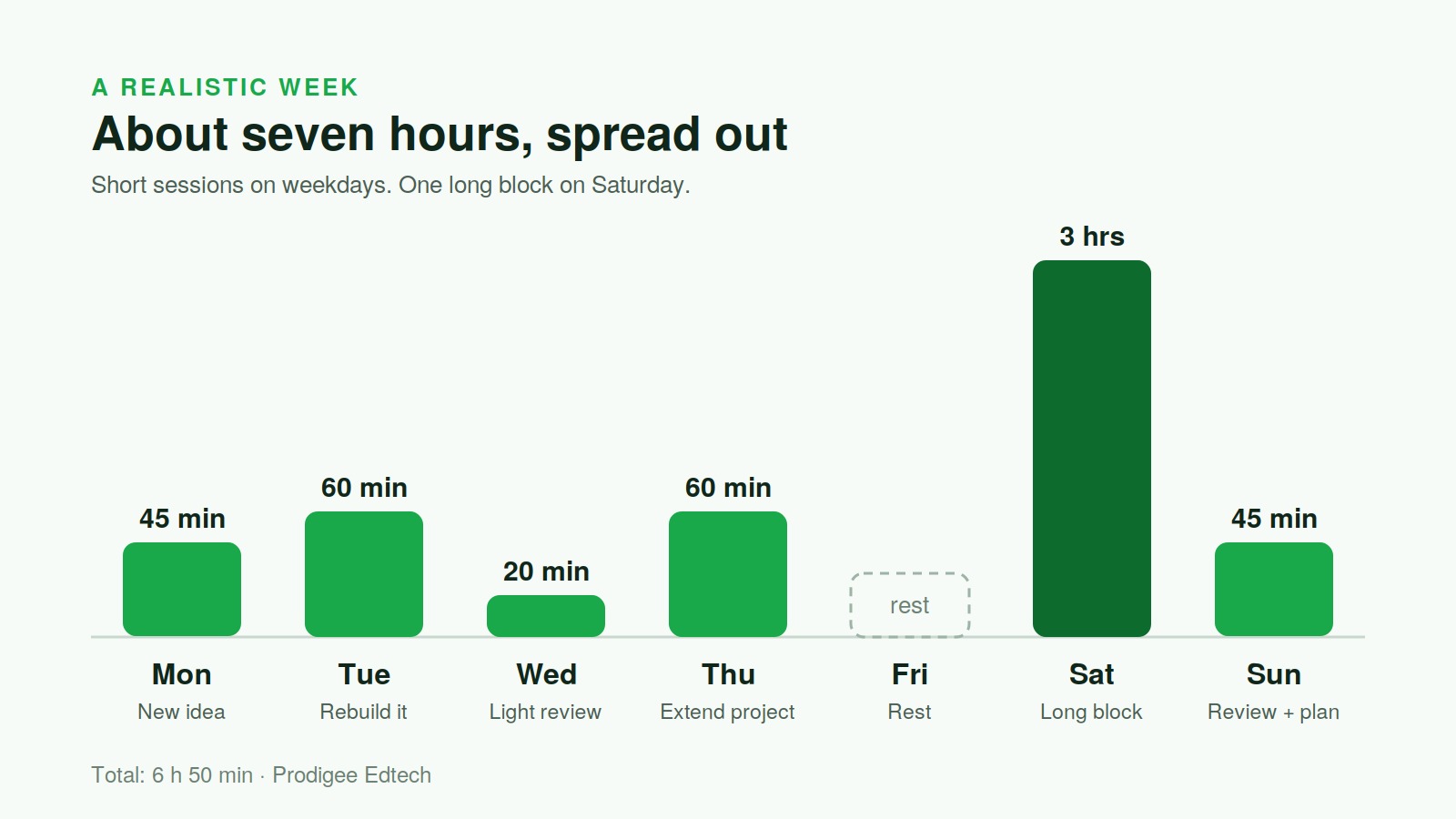
Here is one week, built around just under seven hours. It is a template, not a prescription. If you work shifts, or your evenings belong to a family, move the blocks around and keep the shape.
Monday, 45 minutes: one new idea
One lesson, one concept, and stop there. The aim is to meet the idea, not to master it.
Tuesday, 60 minutes: rebuild it from memory
Close the lesson and make something small with yesterday's idea, without the video open. This is the practice testing the research rates so highly, and it is the hour that keeps you out of tutorial hell.
Wednesday, 20 minutes: light review
Reread your notes or fix one small bug in Tuesday's work. Midweek is where most plans die, so keep this one almost embarrassingly small.
Thursday, 60 minutes: extend your project
Add one feature to the project you started in week one. One feature, not three.
Friday: rest
A real rest day, written into the plan so that taking it is not a failure. After a full week of work, a free evening is part of what keeps the other six going.
Saturday, up to 3 hours: the long block
Your project, in one sitting, early in the day while you are fresh. This is where the real debugging happens, the kind that needs a stretch of unbroken time. Take a proper break in the middle.
Sunday, 45 minutes: review and plan
Look back at what you built, write down what confused you, and decide the first thing you will do on Monday. Walk into the week with the first step already chosen.
What seven hours adds up to
Be honest about the arithmetic, because most of the timelines you have seen assumed more. One guide puts a learner studying eight to ten hours a week alongside a full-time job at roughly eight to twelve months to become job-ready. Another, assuming fifteen to twenty hours, gives six to twelve months for the learning alone, and around five to six further months to land a first role.
If you want the quicker version of this timeline, we mapped it month by month in How Long Does It Take to Learn Web Development and Get a Job in Ghana? Just remember that it assumes more hours than you may have.
A rough guide
Slow and unbroken beats fast and abandoned.
Four rules that keep it alive
Set a floor, not just a target
Decide the smallest session that still counts, perhaps twenty minutes, and treat it as a full win on a bad day. The point of a floor is that a hard week lowers your output without taking it to zero. A schedule that only works at full strength will break the first time something goes wrong, and something will.
Stop in the middle of a problem
End a session while you still know what you would do next, and write that next step down before you close the laptop. Tomorrow's first minute then costs nothing, and you skip the slow restart that makes an evening session feel so heavy.
Keep one project running from week one
Courses teach syntax; a project teaches decisions. Pick something small and slightly useful, like a booking page for a friend's small business, and add to it every week. It gives every session somewhere to land, and it is the cure for watching without building.

Plan around your real constraints
If data is expensive or the connection is unreliable, download the week's lessons in one go when you are on a good network, and keep a few exercises that work offline for the nights the power goes out. A plan that ignores these things is a plan for somebody else's life.
What is worth the hour
With seven hours to spend, every hour has a cost, and a few popular habits are expensive.
Worth the hour
- Rebuilding last week's lesson from memory
- Adding one small feature to your own project
- Reading an error message all the way through
- Asking a specific question in a learner community
Not yet
- Comparing courses for a third week
- Watching lessons at double speed without typing
- Starting a second language before the first one sticks
- Polishing a note-taking system
None of the items on the right is forbidden. They are simply the things that feel like progress and are not, which makes them the first to cut when hours are scarce.
When the week falls apart
It will. Overtime, a family event, a stretch of travel, a few bad days in a row. The usual advice is to catch up, and it is the worst advice on offer, because the growing pile of missed hours is exactly what makes people quit.
Do the opposite. Skip the backlog and return to the plan at your next session. Use the floor to restart: twenty minutes, one small thing, the step you wrote down before you stopped. The schedule survives a missed week because the goal is measured in months, not days.
Start with the first hour
A schedule only helps if there is something structured to put inside it. Prodigee's courses are built from short lessons and small projects, which is the shape a working week can actually hold: an idea on Monday, a rebuild on Tuesday, a feature on Thursday.
Make the first hour count
Short, project-based courses designed to fit around a working week.
Browse coursesFrequently asked questions
- How many hours a week do I need to learn to code while working full-time?
- Sources vary. The median self-taught learner studies about eight hours a week, Codecademy suggests five to fifteen for a fast career change, and part-time bootcamps typically ask for ten to twenty. Around seven to ten focused hours is a realistic place to start, provided you can keep it up week after week.
- Is it better to study every day or in longer weekend blocks?
- A mix works best. Short, regular sessions during the week use the spacing effect, which research rates as high utility, while one longer weekend block gives you the unbroken time that real project work and debugging need.
- How long will it take to get job-ready if I study part-time?
- At roughly eight to ten hours a week, one widely cited guide estimates eight to twelve months to become job-ready. More weekly hours shorten that, and so does prior experience, so treat any figure as a range rather than a promise.
- What should I do if I miss a week?
- Do not try to make up the lost hours. Return to the plan at your next session, start with a short floor session of around twenty minutes, and pick up from the next step you noted before you stopped.
References
This article draws on the following sources, linked so you can read further.
- How Long Does It Take to Learn to Code? A Realistic Timeline, ScrimbaMedian weekly study hours for self-taught learners, and a sample weekly schedule for people working full-time.
- How Long Does It Take to Learn to Code?, CodecademyRecommended weekly hours for a career change, drawn from learner survey data.
- How Many Hours Does a Coding Bootcamp Take?, Sigma SchoolFull-time and part-time hour breakdowns, and why momentum suffers at low weekly hours.
- How Long Does It Take to Learn to Code in 2026?, NucampTimelines for part-time learners, including the time it takes to land a first role.
- Strengthening the Student Toolbox, American EducatorPlain-language summary of the research review that rated distributed practice and practice testing the most effective study techniques.